
We know the feeling.
You finish a course. Watch dozens of tutorials. Work through examples, complete exercises, and learn how things work.
Then you open a blank project and ask yourself a simple question:
Okay, but what should I actually build now?
Suddenly, there's no finished example to follow. No carefully prepared dataset. No instructor who knows exactly where you're going to get stuck.
There's just an idea, a problem, and many possible paths toward a solution.
Maybe that's where the most important part of learning begins.
Knowledge Waiting to Be Put to Use
Access to knowledge has never been easier.
Courses, documentation, video lessons, open-source projects, and communities are available to almost anyone with an internet connection.
Artificial intelligence has changed how we learn even further. We can ask questions, request explanations, analyze code, and explore possible solutions faster than before.
But having access to knowledge isn't the same as knowing how to apply it.
You might understand how databases work, yet find yourself facing completely new questions when you have to design the data structure for your own application.
You might know the principles of good design, but only realize why a particular button is in the wrong place after watching real people use your product.
You might write excellent content, but discover how much context matters only when that content becomes part of a larger user experience.
Knowledge takes on a different kind of value when we start putting it to work.
What If We Started with a Problem Instead of a Lesson?
Imagine a small group of people coming together to build a simple digital product.
One person knows how to code. Another works in design. Someone else understands user research, content creation, or project management.
Perhaps none of them knows enough to build the entire thing alone.
And that's perfectly fine.
Instead of following the same predefined curriculum, they begin by answering a few questions together.
Who needs this product? What problem does it solve? What's the smallest thing we can build to test the idea? How will we know whether we're moving in the right direction?
Only then do they begin exploring technologies, tools, and possible solutions.
Learning is no longer separate from doing.
We learn because we need that knowledge to take the next step.
Mistakes Aren't an Interruption. They're Part of the Process.
In tutorials, things usually work.
In real projects? Not so much.
Sometimes we misunderstand the problem. Sometimes we choose technology that makes our work unnecessarily complicated. Sometimes we spend days building a feature only to realize that nobody actually needs it.
And those are exactly the kinds of experiences that are difficult to capture in a step-by-step tutorial.
When something doesn't work, we're forced to ask better questions.
What did we assume? What did we overlook? How could we test a different approach? Does this problem really need such a complicated solution?
In this kind of environment, an unsuccessful prototype doesn't necessarily mean unsuccessful learning.
Sometimes, it turns out to be the most useful result we could have achieved.
AI Changes the Tools, but Not the Need to Think
Today, one person using AI tools can accomplish things that once required a much larger team.
We can build prototypes faster, explore different approaches, write parts of the code, analyze information, and prepare early versions of content.
That opens up interesting possibilities, especially for small teams and people who are just getting started.
But there's an important difference between having AI generate something that looks like a solution and actually understanding what we've built.
Who checks whether the application works correctly? Who considers security and privacy? Who decides what users really need? Who takes responsibility when something goes wrong?
AI can help at almost every stage.
But responsibility for the product still belongs to the people building it.
That's why we're particularly interested in how AI can become a tool for learning through creation, rather than simply a way to produce a finished-looking result as quickly as possible.
We Don't All Have to Know Everything
One of the most interesting things about working together is the meeting of different perspectives and experiences.
A developer can learn a great deal from a designer.
A designer may approach a problem differently after understanding its technical constraints.
A content creator might ask a question nobody on the development team thought to ask.
And someone who deeply understands a particular problem may contribute more to a product's success than someone who knows ten programming languages.
A good team isn't built by making everyone think the same way.
It's built when different skills come together around a shared goal.
And perhaps that's the greatest value of this approach to learning.
Not only what we learn individually, but what we become capable of creating together.
AI Product Lab: An Idea We Want to Explore
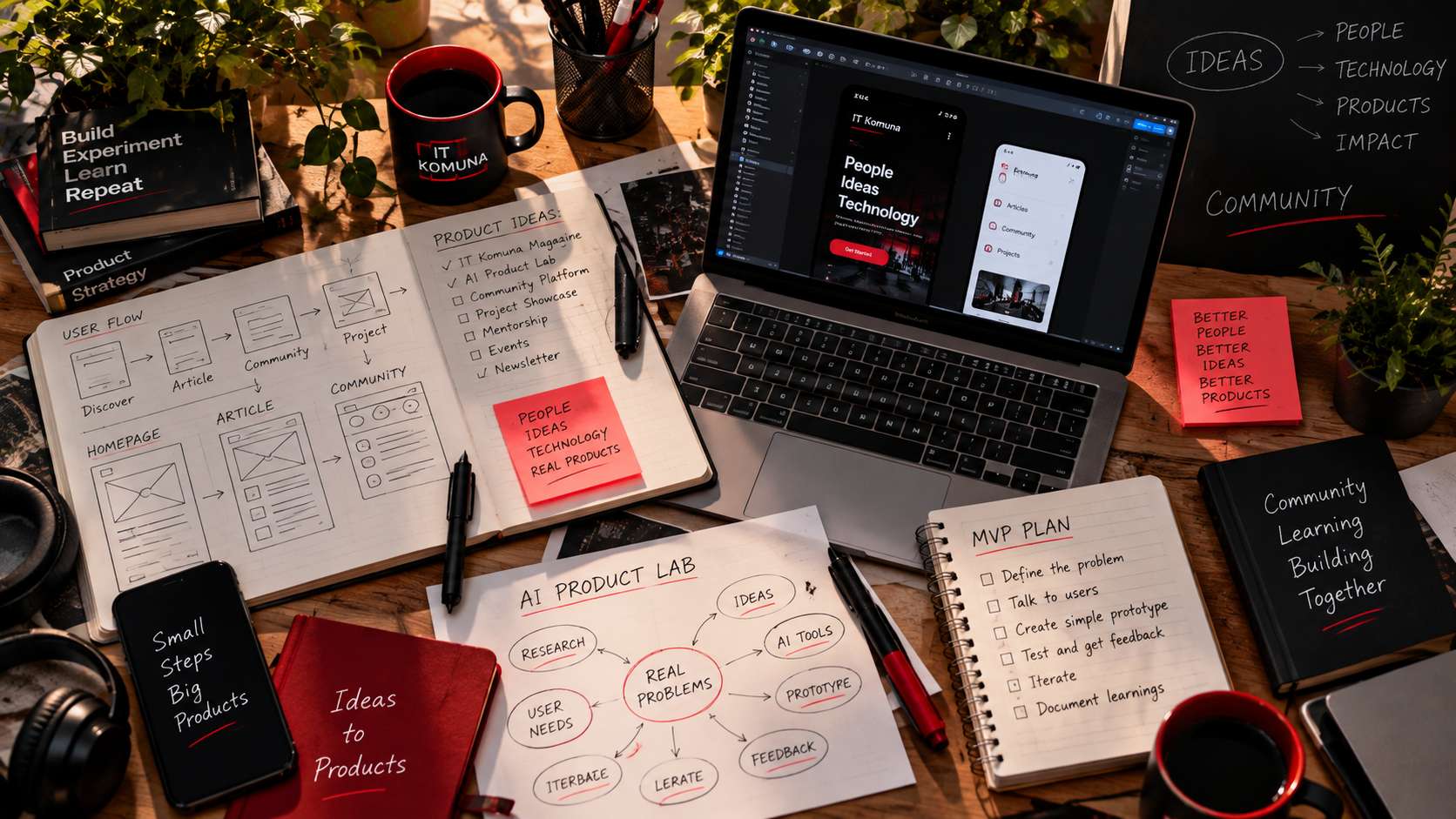
This way of thinking is behind the idea of AI Product Lab, one of the directions we want to develop through IT Komuna.
We imagine it as a space for collaborative exploration, learning, and the development of real digital products, with thoughtful and responsible use of artificial intelligence.
Not a traditional school where everyone follows the same lessons.
Not a competition to see who can generate an application the fastest.
And not a place where presenting an impressive prototype is enough to declare the work finished.
We'd like to explore a model where people work on concrete problems, share knowledge, document decisions, test ideas, and experience together what product development actually involves.
From the first sketch to a working solution.
From initial enthusiasm to the moment when something breaks and needs to be fixed.
From an individual idea to a shared experience.
For now, this is a direction we're developing, not an established program with predefined outcomes or promised results.
And we believe it's important to be clear about that.
But What If the Product Fails?
Maybe this is one of the most important questions.
What if, after several months of work, we discover that an idea doesn't attract enough users? That the problem is different from what we initially believed? That the product can't survive in the form we imagined?
Was all that work wasted?
Not necessarily.
If the participants learned how to research, collaborate, make decisions, solve problems, and understand the consequences of their choices, something valuable was created.
Maybe it wasn't a successful product.
But it was knowledge, experience, relationships, and the ability to build something better next time.
That doesn't mean results should be ignored.
Quite the opposite. We want to create products that make sense and can genuinely help people.
We simply don't want the only measure of success to be whether every idea becomes a commercial hit.
Maybe It's Time to Reconnect Learning with Creating
IT Komuna doesn't want to be just a place where we read about technology.
We want to create room for questions, experiments, conversations, and meaningful work.
AI Product Lab is one of the ideas through which we could explore what such a space might look like in practice.
We don't know all the answers in advance.
We don't know what kinds of products might emerge from these conversations and experiments.
But we do know what feels worth trying.
Bringing together people who want to learn.
Connecting different skills and perspectives.
Using new technologies thoughtfully.
And trying to build something meaningful together.
Because perhaps the best way to learn how to build something is to start building it.
People. Ideas. Real projects.